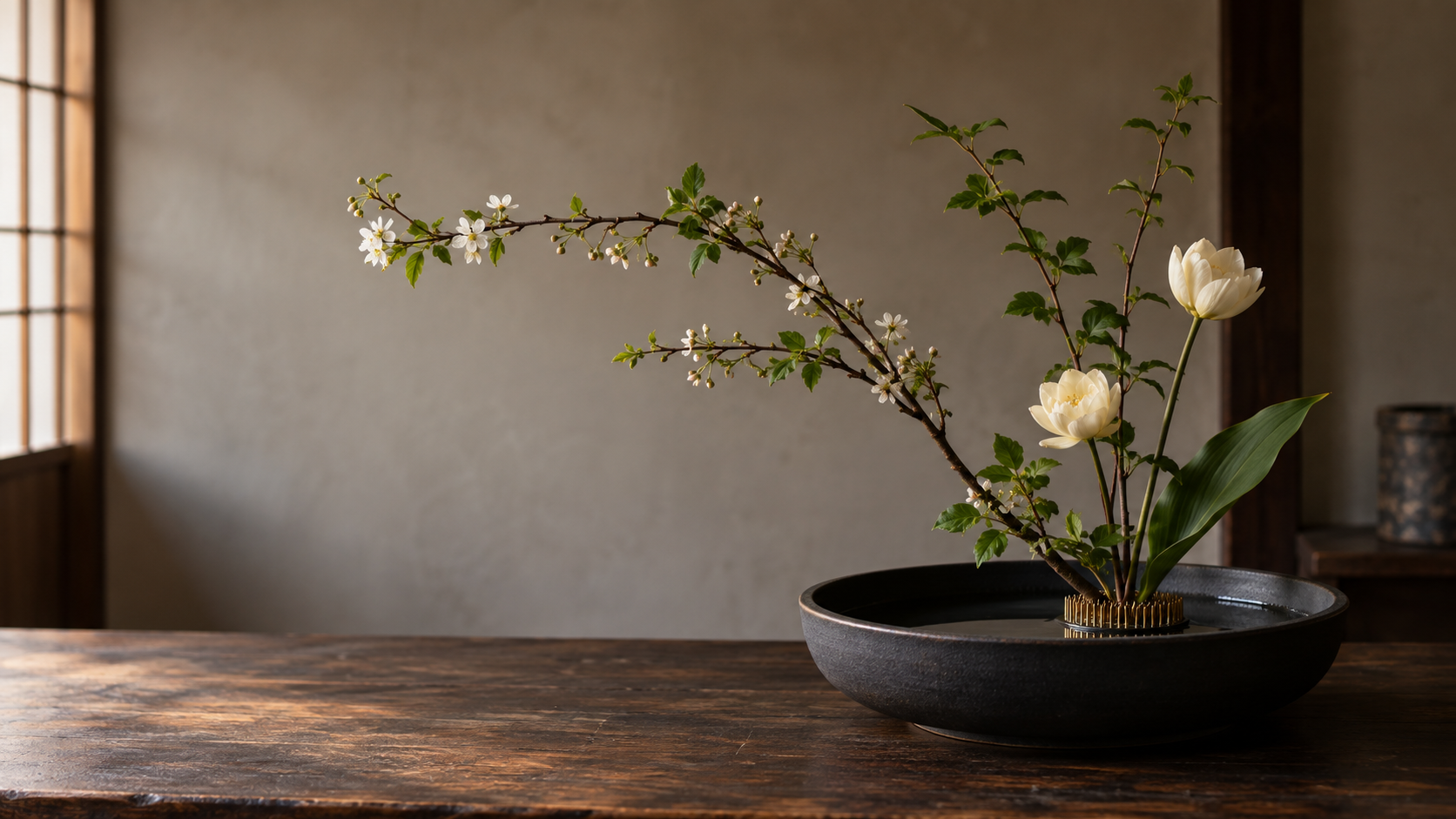
The short answer
For a simple moribana-style arrangement, a beginner can start with a shallow watertight vessel, a weighted pin holder called a kenzan, and clean, sharp floral scissors. Flowers and branches complete the set. You do not need a large collection of specialist tools on day one.
The three core tools
1. Kenzan: the stem holder
A kenzan is a heavy metal base fitted with closely spaced pins. Stems are pressed onto the pins and arranged at deliberate angles. For a first purchase, compare the base diameter, weight, pin density, and whether the underside has a rubber ring to protect the vessel and reduce sliding.
2. Suiban: the shallow vessel
A shallow basin—often called a suiban—leaves the water surface visible and gives low, spreading arrangements room to breathe. Look for a stable base, enough depth to cover the kenzan, and a finish that will not be easily marked by metal. A purpose-made vessel is convenient, but any suitable watertight bowl can be used for practice.
3. Scissors: clean cuts matter
Ikebana scissors have short, strong blades suited to flower stems and small branches. A beginner does not need the most expensive forged pair, but the blades should close cleanly, feel controlled in the hand, and match the thickness of the material being cut. Heavy woody branches may require a separate pruning tool.
Starter set or separate pieces?
Bowl + kenzan set
A practical choice when the dimensions are clearly stated and the holder fits the vessel.
Choose separately
Best when you want a heavier kenzan, a particular bowl size, or better scissors.
Complete tool kit
Convenient, but check whether every included item is useful rather than judging by piece count.
A five-point shopping checklist
- Dimensions: listings should give actual measurements, not only “small” or “large.”
- Weight: a substantial kenzan is less likely to move under angled stems.
- Vessel depth: the pins should be submerged without requiring an excessively deep bowl.
- Protection: check for a removable rubber base or plan to use an appropriate pad.
- Cutting capacity: ordinary flower stems and woody branches place different demands on scissors.
What not to overbuy
Large bundles can look economical while repeating the same low-cost accessories. A compact, well-matched bowl and kenzan usually teaches more than a box of tools with unclear specifications. Begin with one arrangement format; add a taller vase, branch cutters, wire, or additional holders only when a project creates a real need.
Three useful product paths
This guide will compare three distinct purchase types: an affordable bowl-and-kenzan set, a better weighted kenzan paired with a separate vessel, and a Made-in-Japan beginner tool set. Keeping these groups separate makes price differences understandable instead of presenting a random product list.
Affiliate disclosure: As an Amazon Associate I earn from qualifying purchases. Product links will be added only after current listings have been verified.