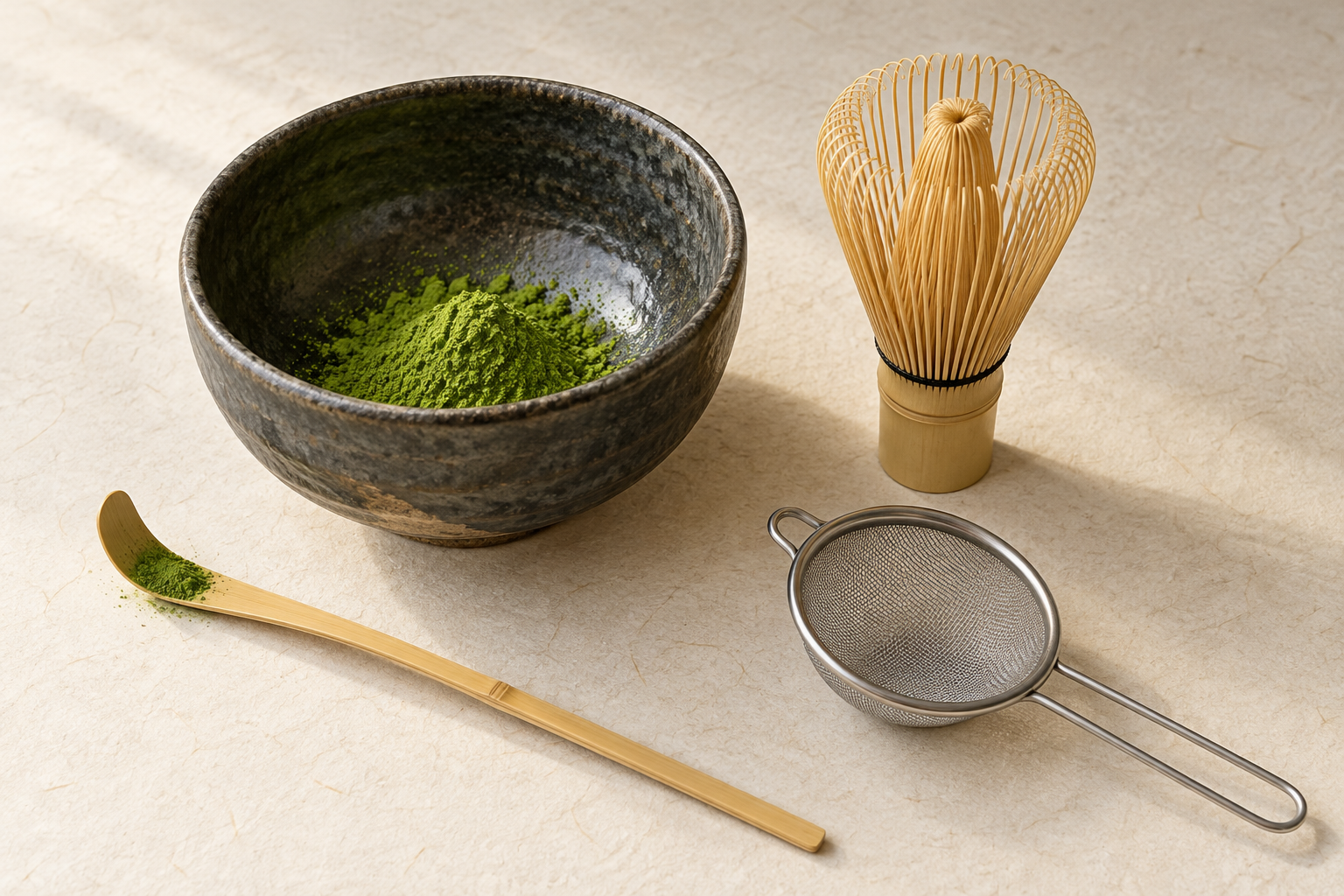
Start with the job each tool does
A beginner setup can stay simple. Ippodo Tea's utensil guidance prioritizes a fine tea strainer for removing clumps and a bamboo chasen for mixing and aerating the tea. A wide bowl gives the whisk room to move. A bamboo scoop, whisk stand, and decorative accessories can be useful, but they are not equally important for the first bowl.
The three tools that matter first
Fine-mesh strainer
Matcha naturally forms small clumps. Sifting before adding water helps the powder disperse quickly instead of leaving dry pockets.
Bamboo chasen
Many fine bamboo tips move through a small amount of tea quickly. Use a light forward-and-back motion and avoid grinding the tips into the bowl.
Wide bowl
A bowl with enough width and depth lets the whisk move without striking the sides or splashing. A purpose-made chawan is helpful, but a suitable bowl you already own can work for practice.
Useful, but not automatically essential
Chashaku
The curved bamboo scoop reaches into narrow tea containers and feels pleasant to use. A level measuring spoon is easier when repeatable grams matter.
Whisk stand
A stand supports the whisk's rounded form while it dries. It does not replace rinsing, airflow, or replacing a whisk with many broken tips.
Electric frother
Useful for lattes and convenience, but it is not a direct substitute when your goal is to learn the texture and motion produced by a chasen.
What to skip in an oversized kit
- Duplicate scoops or tiny serving tools that do not improve whisking.
- A narrow bowl chosen for appearance but too cramped for the whisk.
- Unspecified bamboo whisks sold without care guidance or clear photos of the tips.
- Claims of “ceremonial authenticity” based only on the number of pieces.
Shopping paths — choose by what is missing
Build the smallest setup that solves your problem
If you already own a wide bowl, start with a whisk and strainer. Choose a complete set only when its bowl dimensions and included tools are clearly listed. Search results, prices, sellers, and availability can change, so verify the current listing before ordering.
Whisk first
Browse bamboo chasen on AmazonAdd a fine strainer
Browse matcha strainers on AmazonCompare complete sets
Browse beginner sets on AmazonAffiliate disclosure: As an Amazon Associate I earn from qualifying purchases. These are category search links, not hands-on product endorsements.
A simple first-bowl workflow
- Sift about 2 g of matcha into a wide bowl.
- Add about 60 mL of water cooled to roughly 80°C / 176°F.
- Whisk quickly for about 15 seconds with a light forward-and-back motion.
- Rinse the whisk in clean water, shake off excess water, and let it dry with airflow.
Sources & method