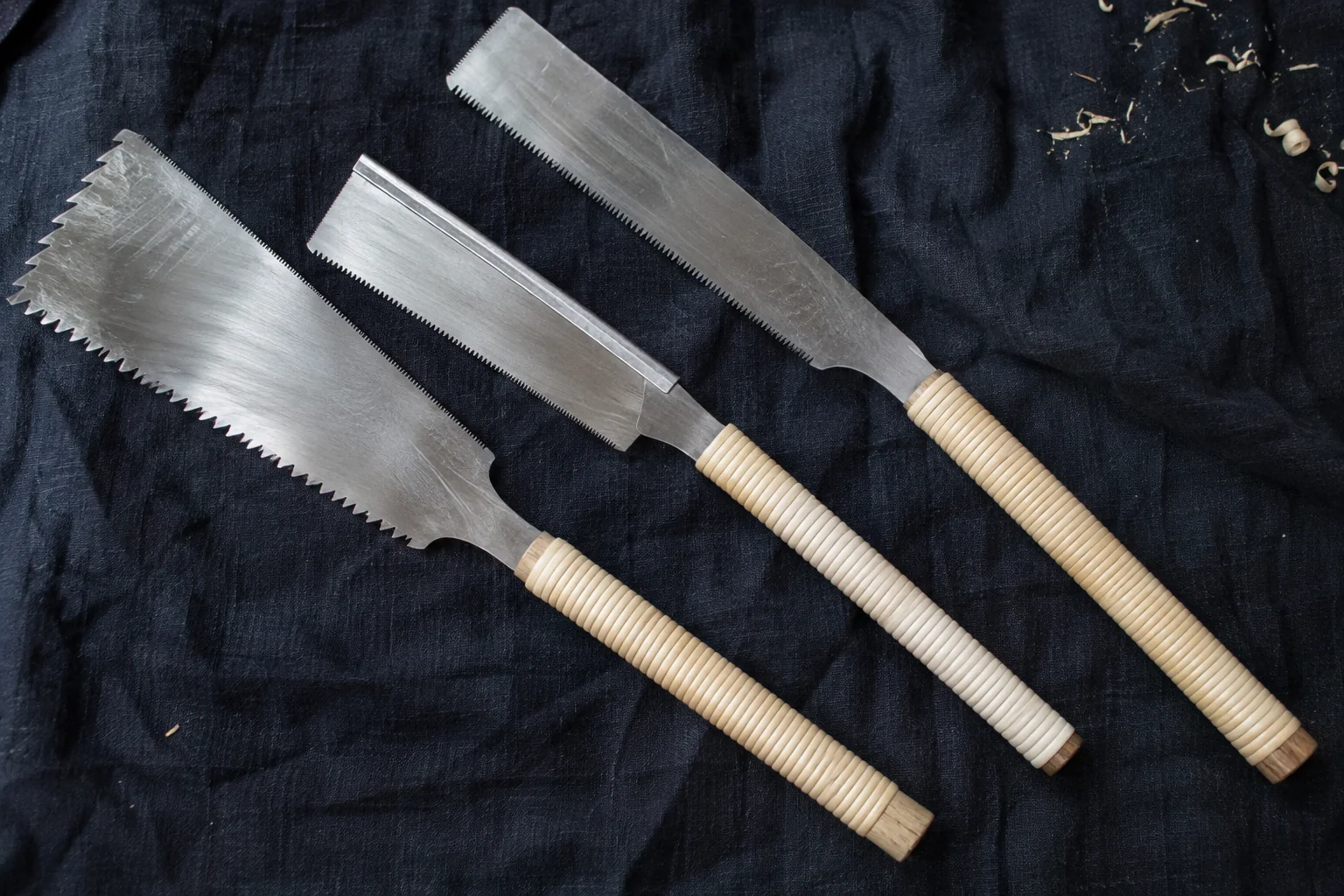
What changes when the saw cuts on the pull?
Razorsaw Manufacturing’s guidance on rip and crosscut teeth explains that the blade cuts when pulled and should return without force. If you are familiar with a push-cutting hand saw, change where you apply effort: draw the teeth through the wood, then ease off for the return.
Let that distinction guide your first practice cuts. Aim for a controlled movement rather than a hard shove in either direction. A pull saw is a tool to learn, not a shortcut that makes a straight cut automatic. Choose the tooth pattern for the direction you intend to cut before comparing brands.
Ryoba vs dozuki vs kataba: compare the three shapes
Look at the cutting edges and the back of the blade. Those features offer a clearer starting point than the word “Japanese” in a product title. The table describes the types discussed here; confirm the actual tooth pattern and dimensions on each listing.
| Type | Blade and back | Cuts to consider | Depth | As a first saw |
|---|---|---|---|---|
| Ryoba | Two toothed edges; no spine | Rip and crosscut, using the appropriate edge | No back to limit depth; check blade size and access | Our default for mixed beginner projects |
| Dozuki | One toothed edge; stiffening back | Small, precise joinery cuts; check teeth for the intended cut | The back limits how deep the blade can enter | Choose for a specific joinery project |
| Kataba | One toothed edge; no spine | The linked model is a crosscut saw | No back to obstruct deeper cuts; check dimensions | Choose for board crosscuts when depth matters |
A dozuki’s back is useful until it reaches the wood. Compare your intended cut depth with the maker’s stated usable depth, not just blade length. A kataba avoids that obstruction, but its single edge still needs to suit your cut.
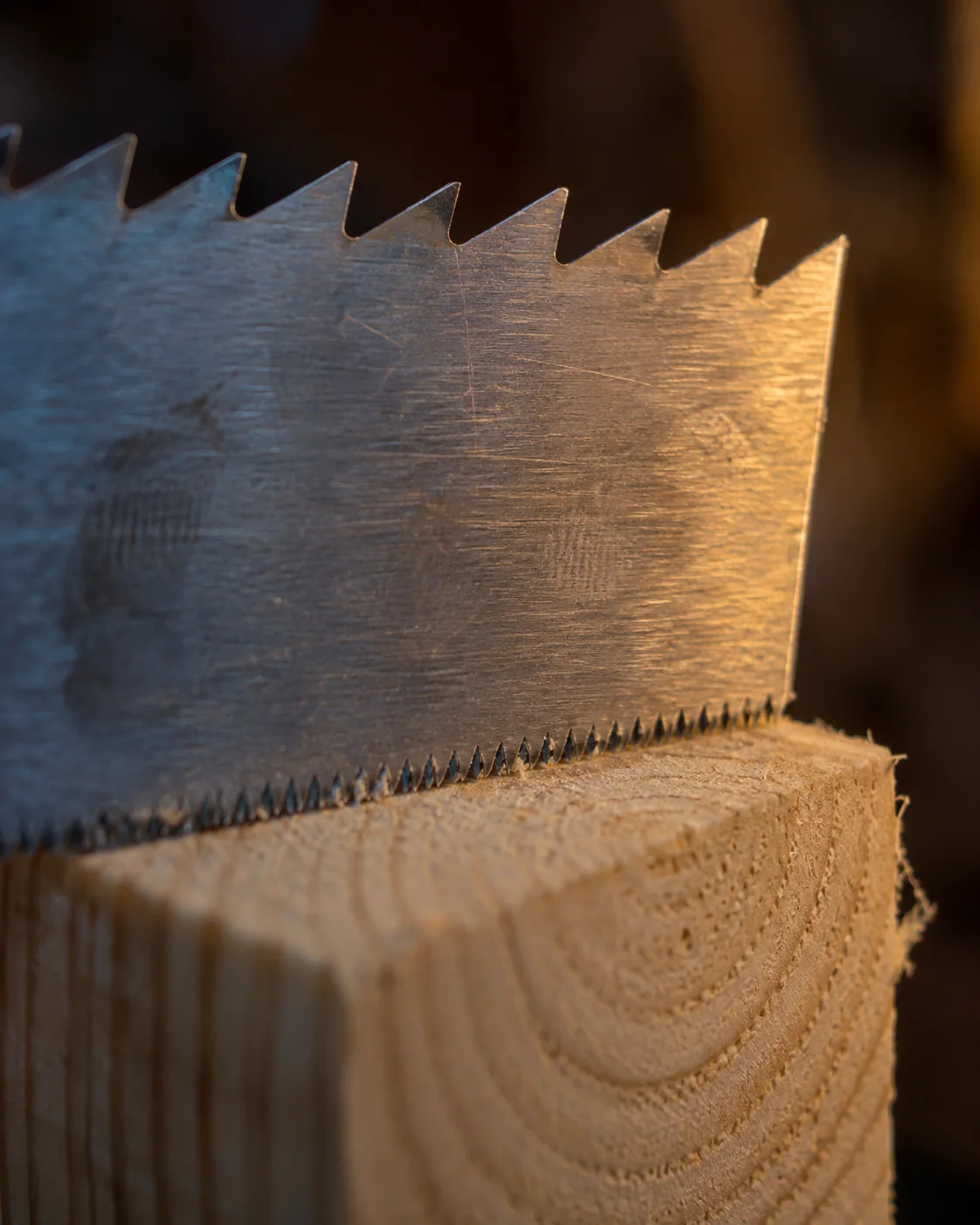
AI-generated editorial illustration; not a product photograph.
Rip and crosscut teeth do different jobs
According to Razorsaw Manufacturing’s guidance linked above, crosscut teeth cut across the wood grain. Their pointed cutting edges work like small knife edges. Rip teeth cut parallel to the grain; the maker describes flat-ended cutting edges resembling small flat chisels. These are different cutting shapes, not simply two levels of sharpness.
On the linked ryoba listings, one edge serves each direction. When shortening a board, identify the crosscut edge. When dividing a board along its grain, identify the rip edge. Read the saw’s labeling and instructions rather than relying only on which side looks finer.
TPI means teeth per inch. The SUIZAN ryoba listing’s 9 TPI and 15 TPI describe its two edges; they are not a universal specification for all ryoba saws. Compare tooth counts alongside intended use rather than choosing the largest number as though it were a quality score.
Choose from your first project
Write down the next thing you want to make and the cuts it needs. This is an editorial way to narrow the choice, not a claim that only one saw type can do each job. Japanese chisels and planes are separate topics; this guide does not give buying advice for either.
Start with the crosscut
A ryoba gives you a crosscut edge now and a rip edge to explore later. Consider the linked crosscut kataba if thicker stock and unobstructed cut depth are your main concern. Check the board and saw dimensions before deciding.
List both cutting directions
If the plan includes shortening boards and cutting along the grain, a ryoba is our suggested first purchase. Work out whether the project actually calls for both operations before buying separate saws. A project name alone does not specify its cuts.
Check the joint and depth
Consider a dozuki when small, controlled joinery cuts are the goal. Confirm the tooth pattern suits the joint’s cutting directions and that the back clears the intended depth. A listing’s joinery description does not answer those questions for every joint.
If you still cannot name a project, choose the ryoba route and practice both cutting directions on scrap. There is little reason to assemble a complete saw collection before you know which operation you want to repeat.
Check replacement blades before buying
Replaceable-blade saws are designed so you swap the blade when it dulls. Whether a particular blade can be resharpened depends on the model and the maker’s guidance. Do not assume every Japanese blade has the same maintenance requirements.
Record the full saw model, blade length, replacement-blade part number, and handle connection. Compare all four with the replacement listing. A shared brand or similar length does not establish that a blade fits. Keep the model information somewhere you can find it when the original packaging is gone.
The linked SUIZAN kataba listing says its separately sold 10.5-inch replacement blade fits only that saw. The Gyokucho hardwood spare-blade listing does not say it fits the 770-3600 ryoba. That uncertainty is why the spare is an example here rather than a recommended companion purchase. Ask the maker or seller to confirm a match before ordering.
Miki’s saw tradition and Banshu Miki uchihamono
The Miki Industrial Cooperative Association records three sawsmith workshops in Miki in 1742. Its saw page describes tooth cutting, setting teeth alternately outward, and finishing their cutting edges. This history gives context to Japanese sawmaking without identifying the origin of every modern saw sold online.
The nationally designated traditional craft Banshu Miki uchihamono refers to tools made with the traditional forging methods of the Miki production area in Hyogo Prefecture. Designated in 1996, it covers five categories: saws, chisels, planes, trowels, and small knives. KOGEI JAPAN describes the area’s forging tradition. The replaceable-blade saws linked here are factory-made tools, not designated craft pieces.
Razorsaw Manufacturing lists its address in Ono, Hyogo Prefecture, the same prefecture as Miki. That address does not justify calling the linked Gyokucho or Razorsaw saws “made in Miki.” The dozuki listing says “Made in Japan”; the SUIZAN ryoba listing says its saw is made by sawmakers in Tsubame-Sanjo, Niigata. The latter is a listing statement, not an independently verified origin claim.
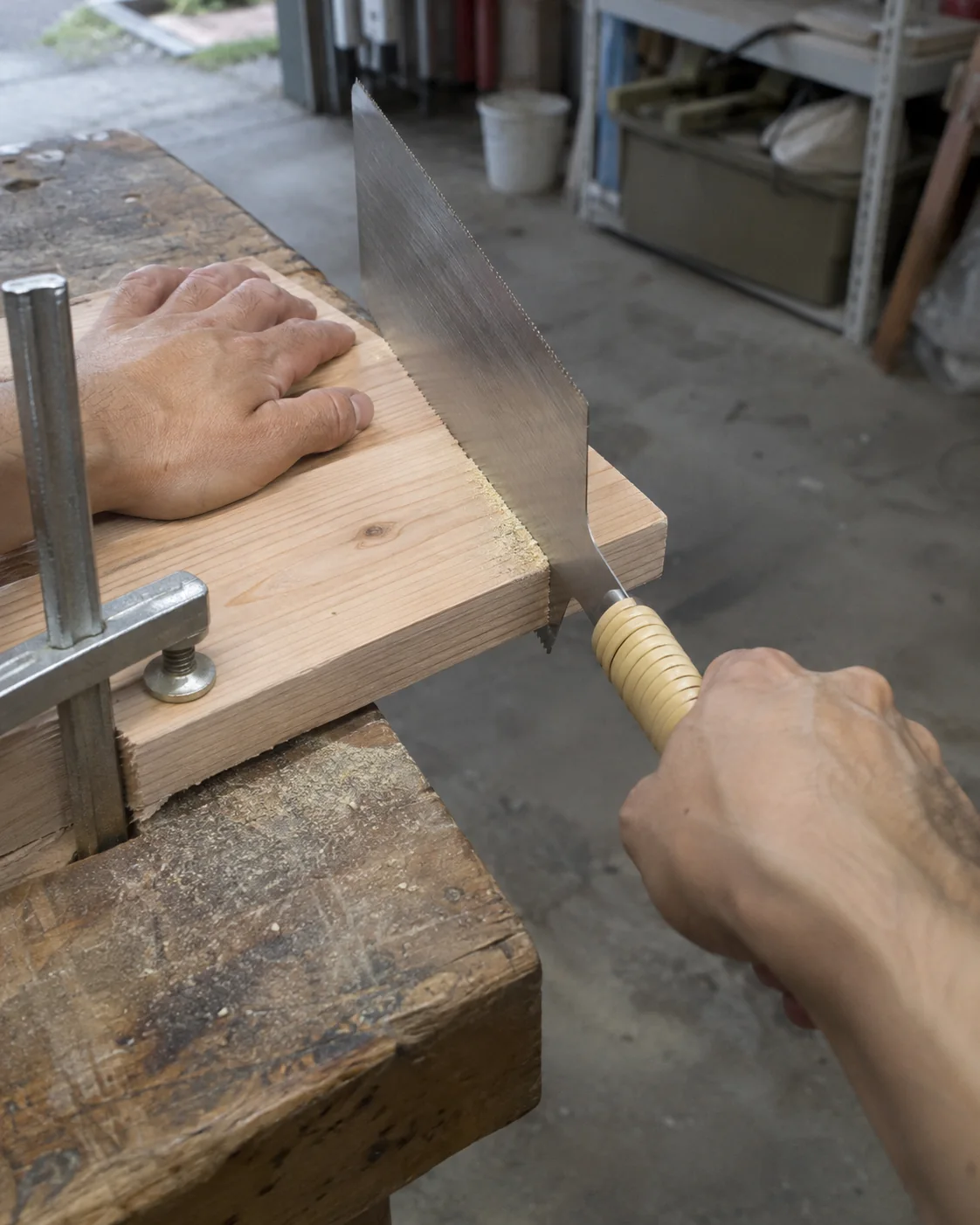
AI-generated editorial illustration; not a product photograph.
Keep the first practice cuts simple
Secure the workpiece and keep your free hand out of the blade path. Start with scrap so you can concentrate on the line and the cutting direction instead of the finished piece. Follow the maker’s instructions for the saw you buy.
Use Razorsaw Manufacturing’s pull-stroke advice: the blade cuts on the pull; return without force. Resist the urge to add effort when a cut feels awkward. Pause, check that the workpiece is secure, and check that you have selected the edge intended for that cut.
When you finish, keep the blade dry and cover the teeth in storage. Put the model and replacement information with your tool notes. These are general care and safety reminders, not a substitute for the maker’s instructions or practical instruction in your workshop.
What to read next
For another kind of Japanese hand tool, read the bonsai tools guide; its subject is plant care rather than woodworking. If you are shopping for someone else, browse Japanese craft gifts under $50 before choosing a specialized saw without knowing the recipient’s projects.
Quick answers before you choose a saw
Is a ryoba or dozuki better for a beginner?
Our default is a ryoba for exploring rip cuts and crosscuts with one saw. Choose a dozuki first when small joinery is your immediate purpose and its tooth pattern and usable depth match the joint. The project is a more useful deciding factor than a beginner label.
Can Japanese saw blades be sharpened?
It depends on the blade model and the maker’s guidance. Replaceable-blade saws are designed around changing a dull blade. Confirm resharpening advice for your exact blade rather than assuming all Japanese saws can, or cannot, be sharpened.
Are these saws made in Miki?
We do not identify any linked saw as made in Miki. Razorsaw Manufacturing lists an Ono address, and the Gyokucho dozuki listing says “Made in Japan.” The SUIZAN ryoba listing names Tsubame-Sanjo, Niigata. None of those statements makes these factory-made tools designated Banshu Miki craft pieces.
Sources & method
Primary references
- Miki Industrial Cooperative Association — Miki metal tools: 1996 designation and the five tool categories.
- Miki Industrial Cooperative Association — saws: historical sawsmiths and tooth-making processes.
- KOGEI JAPAN — Banshu Miki uchihamono: production area and forging tradition.
- Razorsaw Manufacturing — rip and crosscut guidance: tooth shapes, cutting directions, and the pull stroke.
- Razorsaw Manufacturing — company profile: the company’s Ono address.
Listing details were checked on Amazon on November 16, 2026. No products were tested for this article. The five product links above identify the listings supplied for this guide; confirm current specifications and compatibility before buying. Project choices are editorial recommendations. Illustrations explain saw types and are not photographs of the listed products.
Affiliate disclosure: As an Amazon Associate I earn from qualifying purchases.