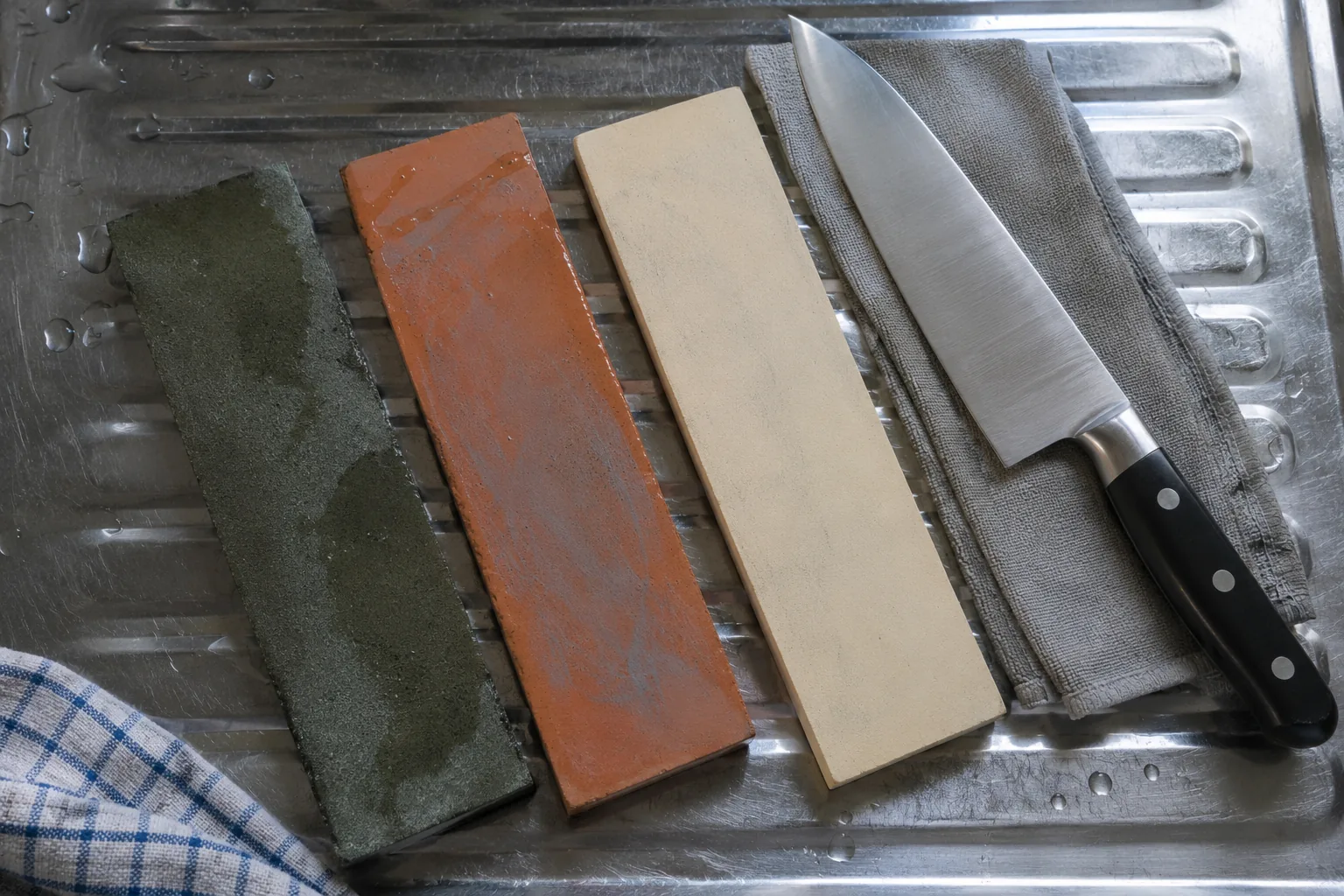
Read the grit number before the stone’s name
In the grit categories described by Kai and Suehiro, higher numbers mean finer grits. Coarse, medium, and finishing describe different jobs, not a collection every beginner needs to complete. Read the number alongside the maker’s explanation of its intended use.
Kai divides rectangular whetstones into coarse stones for repair, medium stones for ordinary resharpening, and finishing stones for smoothing the edge afterward. Start by separating repair from everyday sharpening. A damaged edge and a dull edge do not automatically call for the same first purchase.
Two Japanese makers draw the grit lines differently
The table follows Kai, a knife maker, and Suehiro, a Japanese whetstone maker. Their boundaries differ: even “medium” covers different ranges. Keep the numbers attached to the source rather than treating one chart as a universal definition.
| Category | Kai (knife maker) | Suehiro (whetstone maker) |
|---|---|---|
| Coarse | #200–#400: rust removal, chipped-edge repair, and reshaping | #60–#240: grinding off a nicked edge or reshaping |
| Medium | #800–#2000: general resharpening | #320–#800: general sharpening; #1000–#1500: pre-final sharpening |
| Finishing | #3000–#4000: smoothing after medium sharpening | #2000–#6000: final sharpening |
| Extra-fine finishing | #6000 and up: more delicate finishing; often used for sashimi knives (yanagiba) | #8000–#20000: super-fine final sharpening |
The two makers draw the lines differently, but #1000 sits in the everyday-sharpening band in both. Suehiro calls its part of the medium range “pre-final sharpening.” That shared starting point matters more for this purchase than making the category names match.
Why #1000 is the first stone to consider
Kai explicitly recommends a medium #1000 stone as the one to own first, describing it as versatile and suited to everyday resharpening. Tojiro likewise points to a stone around #1000 when a knife’s cutting performance becomes dull. Our starting recommendation follows those statements.
For a beginner choosing what grit whetstone to buy for a Japanese kitchen knife, that gives a clear place to begin. Decide whether you want a single #1000 stone or a combination that includes it. You can leave the second grit undecided until you have a specific reason to add one.
The #6000 side of a combination is an additional finishing role, not a reason to skip the #1000 side. Kai describes finishing as something that follows medium sharpening. Buying both together is an option; it is not a requirement to buy a complete sequence before you begin.
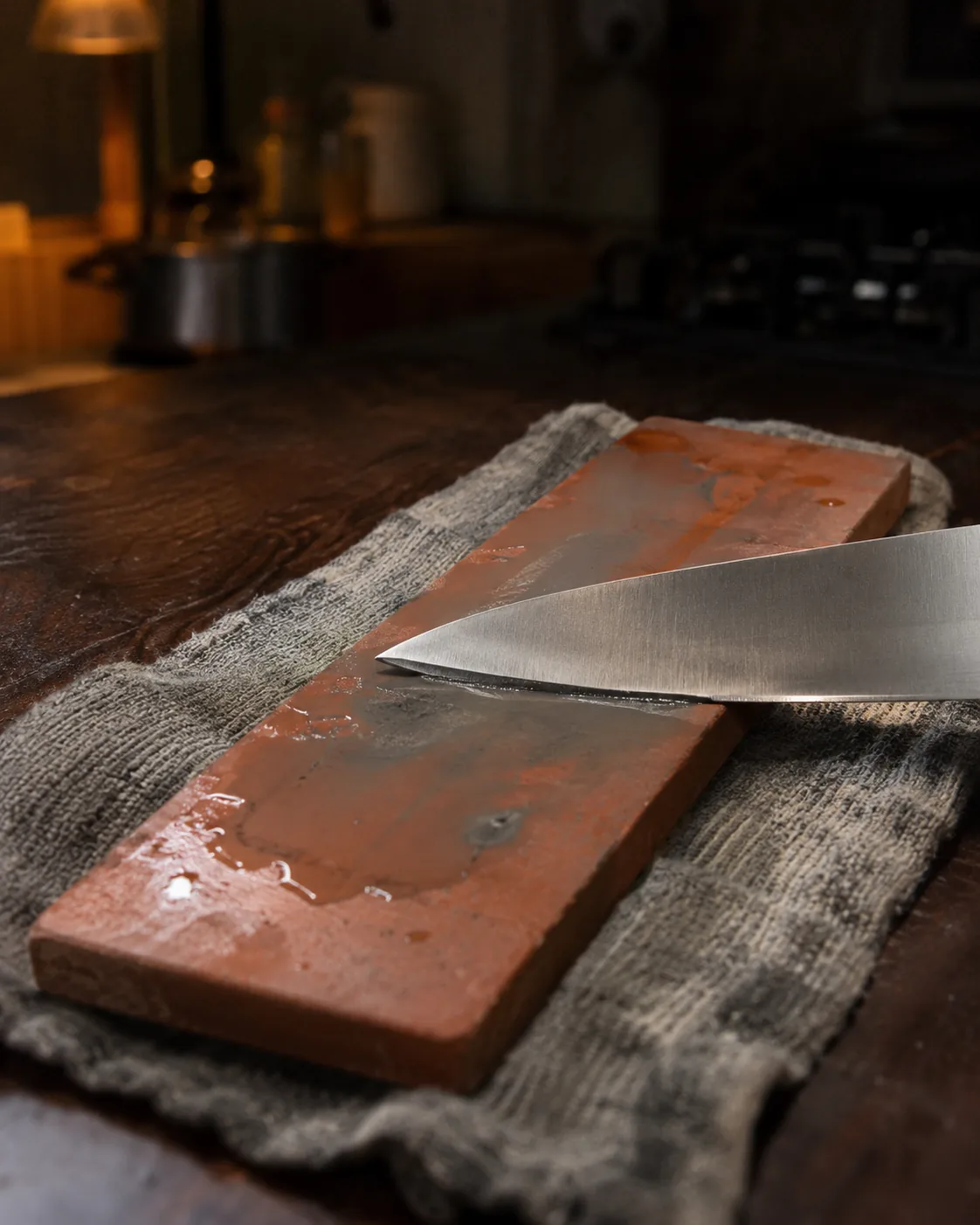
AI-generated editorial illustration; not a product photograph.
Choose the second stone from the problem
Before adding another grit, name the problem you want it to solve. These three buying routes follow the makers’ descriptions. The flattening route serves the stone itself, so it belongs in the decision even though it does not add another knife-finishing stage.
Consider a coarse stone
Kai assigns rust removal and chipped-edge repair to #200–#400 and says to start at #400 for chips. Its sharpening guide describes coarse, medium, then finishing for a chipped edge. None of the five links here is a coarse knife-repair stone.
Consider finishing, or a combination
Kai describes #3000–#4000 for smoothing after medium sharpening, with #6000 and up for more delicate finishing. Suehiro’s finishing range includes #6000. A listed #1000/#6000 combination puts the medium and finishing roles in one block.
Choose a flattening stone
Kai says an uneven surface prevents an even edge. Suehiro recommends a flattening whetstone to maintain a uniform surface. The Naniwa listing describes correcting a trough in another stone; that is the problem this option addresses.
Some stones soak; others do not
Do you need to soak a whetstone? The answer depends on the stone. Read these three maker statements side by side rather than applying one soaking rule to every purchase.
| Maker | What its guidance says |
|---|---|
| Kai | Kai’s FAQ says to submerge the stone until bubbles stop so it takes up enough water. |
| Suehiro | “If the whetstone is absorbent, soak it in water thoroughly before sharpening.” |
| Shapton | Its FAQ says its stones do not need soaking. Before the very first use, 5–6 minutes in water gives a smoother feel. Never soak for 30 minutes or more because the stone can soften. |
Follow the instructions for the stone you bought. In particular, do not turn Shapton’s first-use suggestion into a general soaking time. The linked Shapton listing gives little detail; the soaking guidance comes from its FAQ, not the Amazon description.
The King listing says to soak and keep the stone wet during use. Both linked Suehiro listings indicate soaking, but the Cerax 1010 listing gives no time. Check the instructions that accompany the exact stone instead of filling that gap with another maker’s advice.
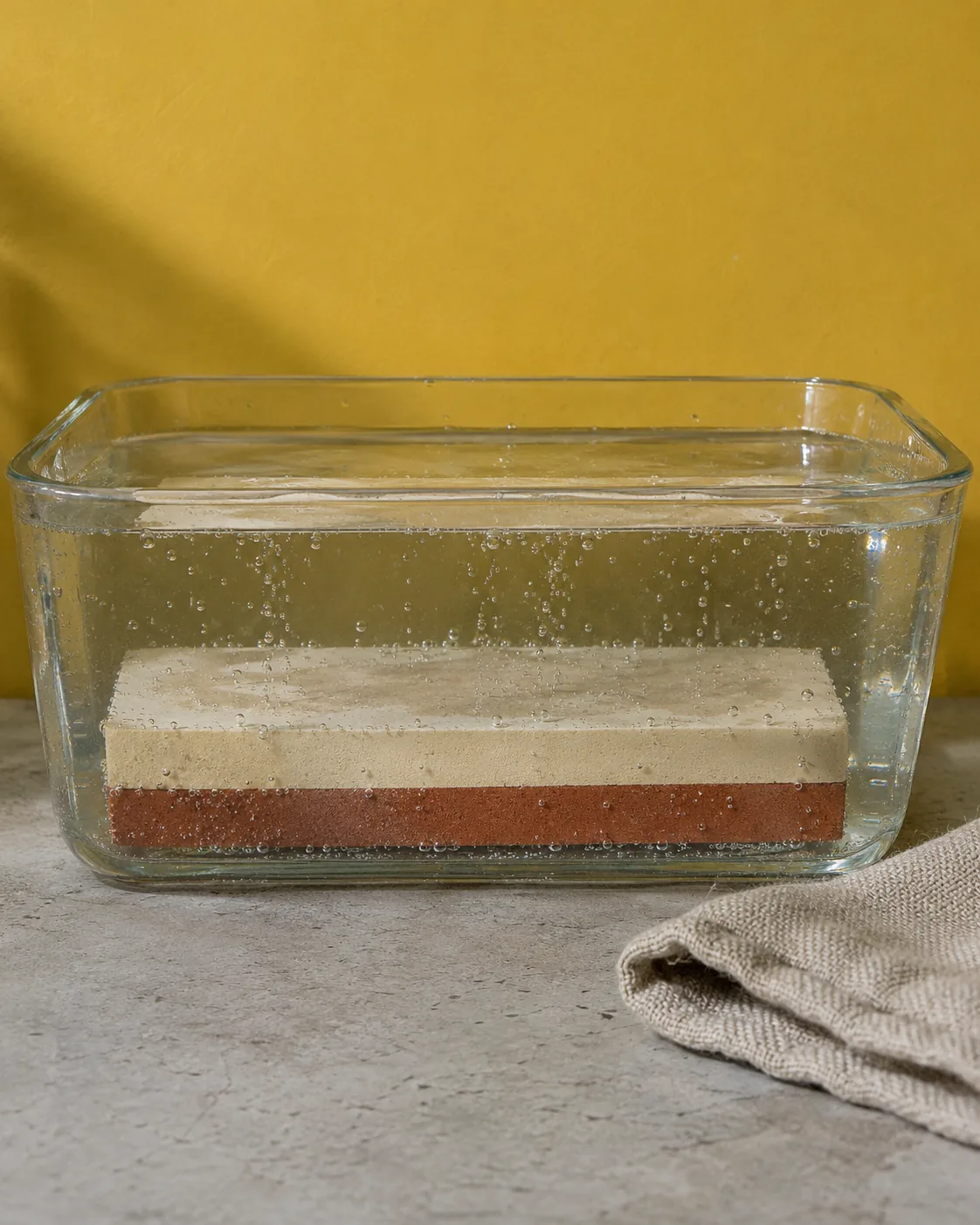
AI-generated editorial illustration; not a product photograph.
Plan for flattening from the start
Kai’s sharpening guide says a rectangular stone becomes dished each time a knife is sharpened and should be corrected each time. Suehiro says an uneven whetstone will not sharpen properly and recommends a flattening stone to maintain a uniform surface. Shapton’s FAQ recommends correcting the surface before each sharpening.
These statements make surface care part of the first buying decision. A finer stone does not address an uneven medium stone. If a kit includes a correction accessory, read what the listing actually calls it: the CR-4800 listing includes a small surface cleaning and correction stone.
Kai warns against flattening on asphalt or concrete because those surfaces roughen the sharpening face. Choose care tools according to the stone’s instructions rather than treating any rough surface as a substitute.
Check the knife and the role of a pull-through sharpener
Kai says ceramic kitchen knives cannot be sharpened with ordinary whetstones or sharpeners. Do not assume that buying the recommended #1000 stone makes it suitable for every knife. Check the knife’s instructions before choosing a sharpening method.
Kai describes a pull-through sharpener as an aid when cutting performance drops, used alongside ordinary care. Its guide distinguishes that supporting role from full resharpening on a rectangular whetstone. For this buying decision, compare the intended jobs rather than assuming the two tools are interchangeable.
After use: drying, storage, and safety
Kai says to dry the stone thoroughly in the shade before storage. Shapton’s FAQ tells owners of one of its stone series to keep those stones in their dedicated case and to wipe moisture from inside the case. Read those care instructions with the soaking instructions, so water preparation and putting the stone away are both part of your plan.
Set the stone so it cannot slide; Kai suggests a stand or a damp cloth. Kai also says force is not needed. Keep your fingers clear of the edge, handle the blade away from yourself, and do not rush with wet hands.
Rinse and dry the knife afterward. Store both knives and stones out of reach of children. These are general safety reminders, not a complete sharpening lesson.
For sharpening technique, use Kai’s guide
This is a buying guide; the full sharpening technique is not taught here. Read Kai’s knife-sharpening guide (Japanese) and follow the instructions for your knife and stone before starting. Choosing a grit is only the purchase decision, not the whole procedure.
What to read next
Our Japanese kitchen knife types guide helps you choose among santoku, gyuto, nakiri, and petty. The Japanese chisels for beginners guide treats sharpening as a separate topic too. Keep that woodworking tool choice separate from the kitchen-knife buying advice here.
Quick answers before you choose a whetstone
What grit whetstone is best for beginners?
Our starting suggestion is #1000, following Kai’s recommendation to own a medium #1000 stone first. Kai describes it as versatile and suited to everyday resharpening. Choose another grit when its stated job matches a specific problem.
Is 1000 grit okay for a Japanese knife?
Tojiro recommends a stone around #1000 when a kitchen knife becomes dull, and Kai recommends medium #1000 for everyday resharpening. Check the exact knife’s instructions; Kai says ordinary whetstones are not suitable for ceramic knives.
Should I use a 6000 grit or 1000 grit stone first?
For ordinary resharpening, start with the #1000 role Kai recommends. Kai places finishing after medium sharpening, while Suehiro includes #6000 in its finishing range. A #1000/#6000 combination offers both roles without making #6000 the starting point.
Do I have to soak a whetstone?
Follow the instructions for the stone you bought. Kai says to submerge until bubbles stop; Suehiro says absorbent stones should be soaked thoroughly. Shapton’s FAQ says its stones need no soaking, suggests 5–6 minutes before the very first use for a smoother feel, and warns against 30 minutes or more.
Sources & method
Primary references
- Kai — whetstone types and selection (Japanese): Grit ranges, first stone, repair, ceramic knives, and care.
- Kai — sharpening a kitchen knife (Japanese): Stone types, grit sequence, flattening, and pull-through sharpeners.
- Kai — FAQ: key points for sharpening on a whetstone (Japanese): Submerging until bubbles stop.
- Suehiro — How to (English): Grit categories, absorbent stones, and flattening.
- Shapton — FAQ (Japanese): Soaking, first use, surface correction, and case care.
- Tojiro — kitchen knife types and uses (Japanese): A stone around #1000 when cutting performance becomes dull.
Listing details were checked on Amazon on November 19, 2026. No products were tested for this article. Buying routes are editorial suggestions based on these maker explanations and listing details. All maker reference pages above are in Japanese except Suehiro’s. Illustrations are not photographs of the linked products.
Affiliate disclosure: As an Amazon Associate I earn from qualifying purchases.