Two broad families, not a catalog to collect
Tojiro, which describes itself as a knife maker in Tsubame-Sanjo, explains two broad families: Western-style knives, mainly double-beveled, and Japanese-style knives, mainly single-beveled. A double bevel has an edge formed from both sides; a single bevel is formed on one side. Tojiro presents double-beveled knives as suitable for home use by left- and right-handed cooks.
That distinction helps explain why this guide begins with everyday shapes rather than specialist blades. Kai says the santoku combines advantages of Japanese- and Western-style knives. The useful question is what you prepare for dinner, not whether a name sounds more traditional. Other shapes, including bunka, kiritsuke, and sujihiki, also exist; they are outside this guide.
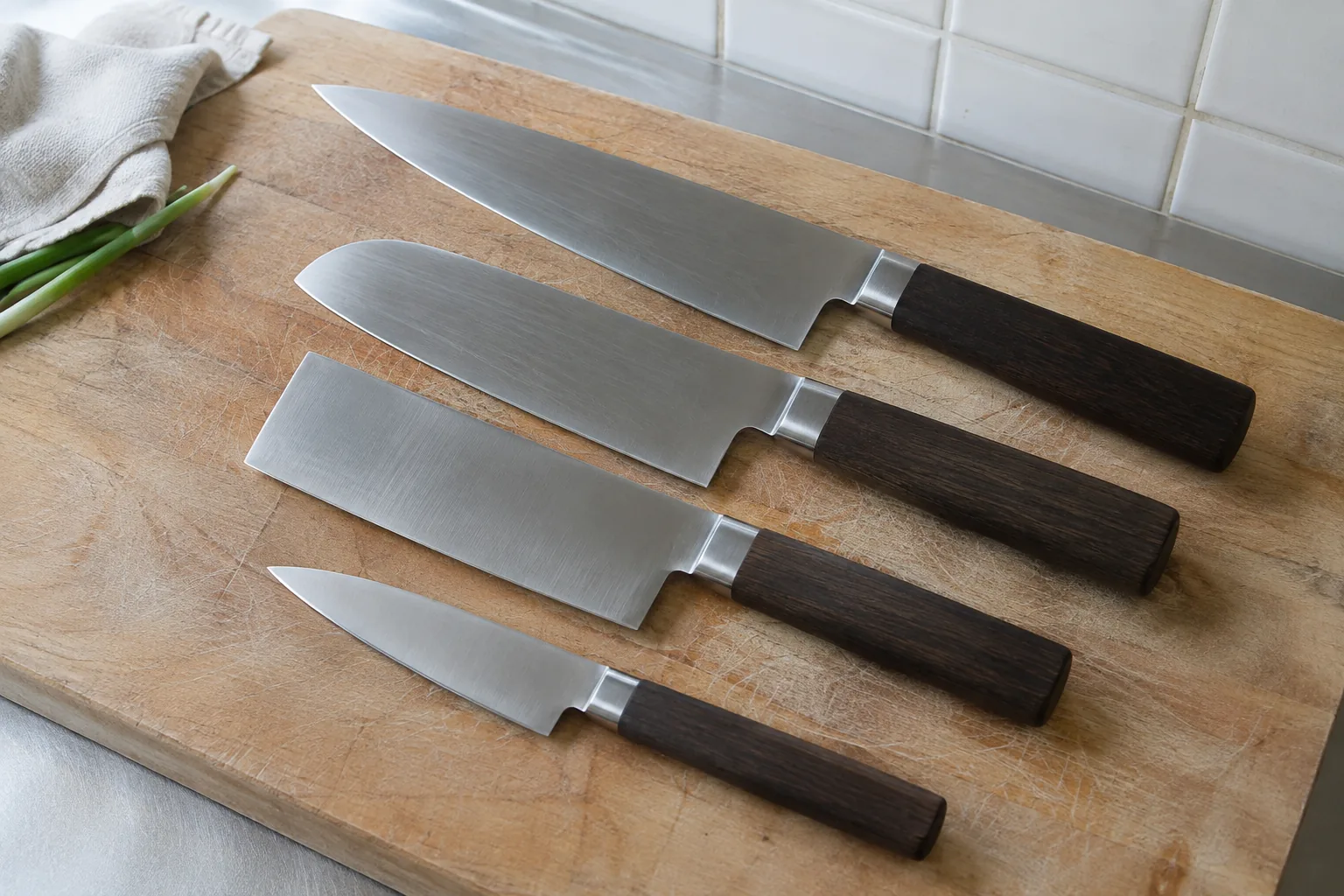
Santoku vs gyuto vs nakiri vs petty
Tojiro gives the typical lengths and uses below. Inch equivalents are rounded. The first-knife column is our editorial recommendation, not a tested ranking; the blade-line descriptions follow Tojiro where stated rather than implying every model has identical geometry.
| Shape | Typical blade length | Blade line or outline | Main work | As a first knife |
|---|---|---|---|---|
| Santoku | 165–180 mm (6.5–7.1 inches) | Straighter cutting line | Push cuts; meat, fish, vegetables | Our default |
| Gyuto | 180–240 mm (7.1–9.4 inches); home range 180–210 mm (7.1–8.3 inches) | Curved toward the tip | Swinging or rocking movement; general prep | Choose for a longer blade |
| Nakiri | Around 165 mm (6.5 inches) | Rectangular blade | Vegetable preparation | Choose for a vegetable-focused role |
| Petty | 120–150 mm (4.7–5.9 inches) | Small blade; check the specific profile | Fruit peeling, garnishes, fine work | Our second-knife choice |
What each shape adds to your kitchen
Santoku: the straightforward starting point
Tojiro describes the santoku as an all-purpose knife for meat, fish, and vegetables—the three uses behind its name. Its straighter cutting line suits push cuts. That makes it our starting suggestion when your meals involve a little of everything and you have no strong preference for a longer chef’s knife. You do not need to buy a gyuto at the same time just to cover another name.
Gyuto: choose the longer general-purpose route
Kai calls the gyuto a chef’s knife and describes it as a general-purpose knife, generally starting at 180 mm (7.1 inches). Tojiro explains using the curve toward the tip in a swinging movement. If that motion appeals to you, compare a gyuto with the santoku before buying. The linked FU-808 listing gives a blade length of 210 mm (8.3 inches); do not confuse blade length with overall length.
Nakiri: make vegetables the deciding factor
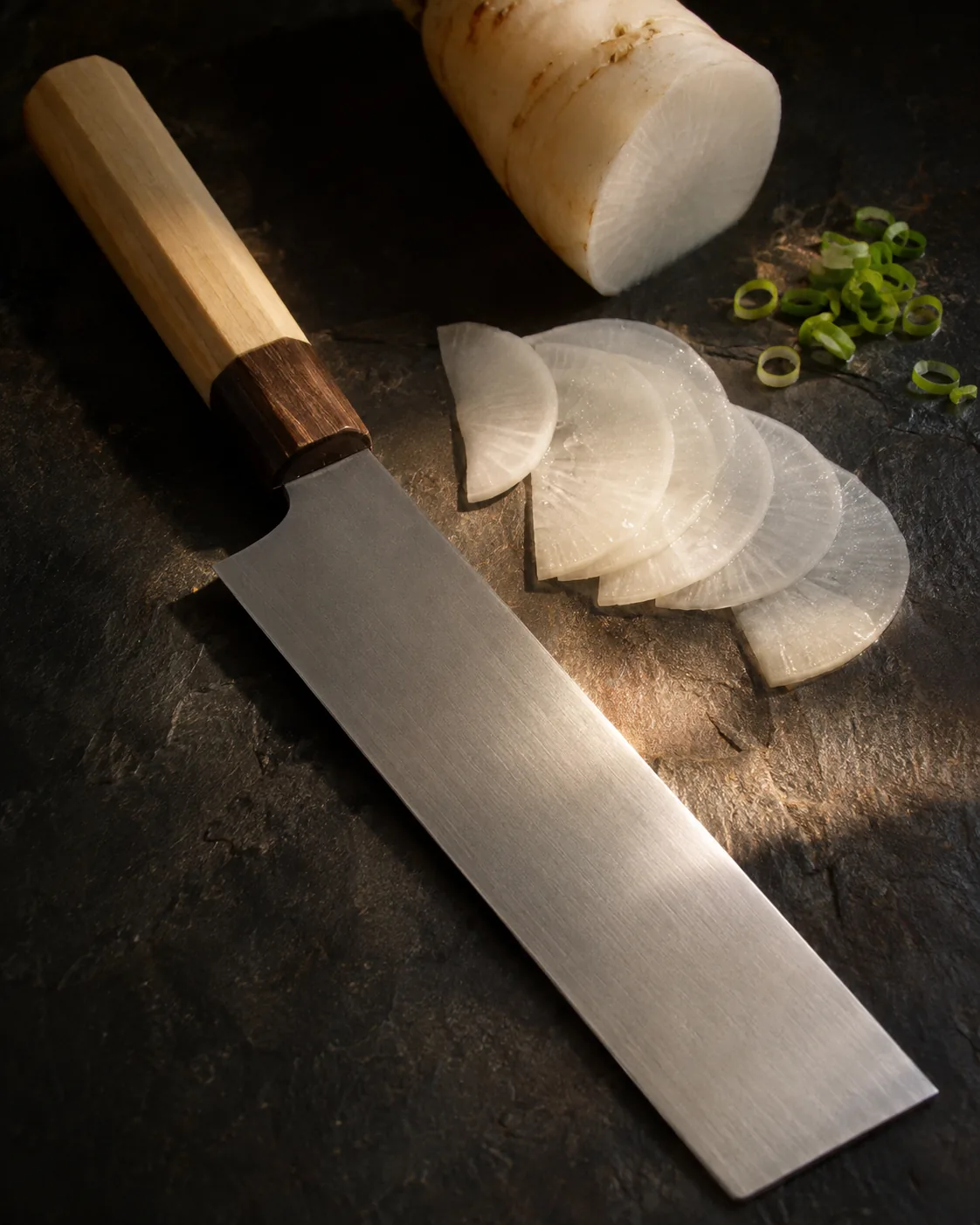
Tojiro describes the nakiri as a vegetable knife with a rectangular blade, around 165 mm (6.5 inches). It also notes that the broad blade can serve as a scraper. Think of the nakiri as a deliberate choice for repeated vegetable preparation, not an automatic upgrade from a santoku. Our two linked nakiri listings offer alternatives for that same role; neither is needed to complete a basic pair.
AI-generated editorial illustration; not a product photograph.
Petty: the small companion
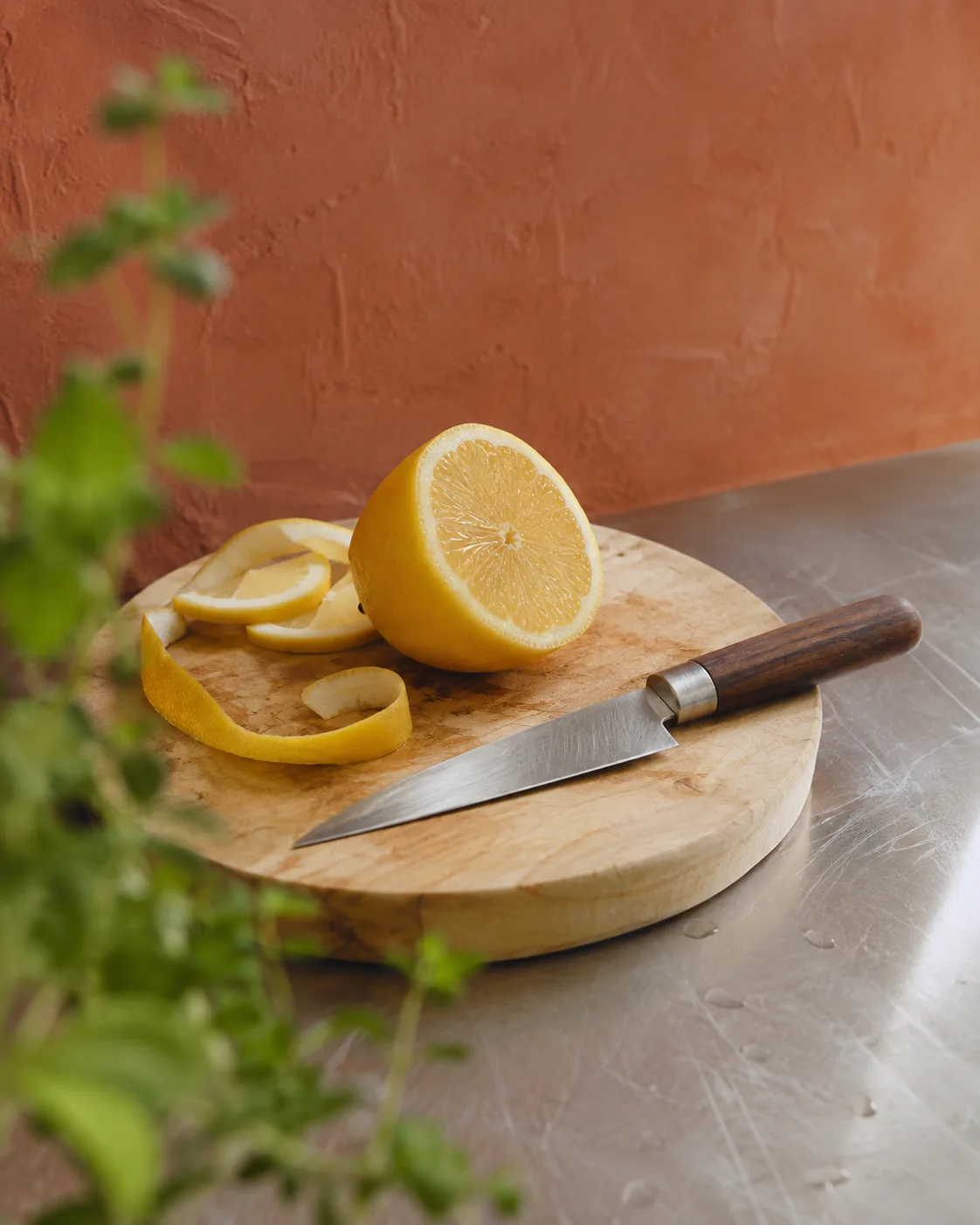
Tojiro assigns the petty to fruit peeling, garnishes, and detailed tasks. Kai likewise describes small work and handheld tasks. Our recommendation is to add one when those jobs feel like a distinct part of your routine. Tojiro recommends both santoku-plus-petty and gyuto-plus-petty combinations. Choose your main knife first, then decide whether a small companion would fill a real gap.
Choose from how you cook
Use an ordinary meal as your example. Separate the work you repeat from the occasional task you imagine doing someday. These are editorial routes through the four shapes, not promises about how a particular product will feel.
Start with a santoku
For mixed meals in a small kitchen, our default is the santoku. If vegetable preparation is the main reason you want a new knife, compare the nakiri instead. Decide whether you want one general-purpose knife or a vegetable-specific role.
Consider a gyuto
If your routine includes pieces of meat and larger vegetables, consider the longer gyuto route. Match that choice to your available workspace and preferred movement. A longer blade is a preference to consider, not evidence of better quality.
Add a petty afterward
When small fruit and garnish tasks recur, consider a petty alongside your main knife. Buying the pair in stages lets you decide whether that smaller role is actually missing from your kitchen.
AI-generated editorial illustration; not a product photograph.
Three single-bevel specialists can wait
In Tojiro’s explanation, yanagiba is for slicing sashimi with a single drawing cut, deba is for breaking down fish and dealing with small bones, and usuba is a vegetable knife whose single bevel helps with katsuramuki peeling. Those are specific jobs. We would not make one the default first knife for an undecided home cook.
The deba’s specialist role is not permission to cut bones with the thin everyday blades discussed here. Choose from your actual task and follow the instructions for the exact knife.
Keep the steel decision simple
Tojiro recommends rust-resistant stainless steels for home kitchens and describes composite constructions with cores such as VG10 or molybdenum vanadium steel as balanced options. That is enough background for this first choice. Read each product’s stated materials without turning a steel name into a claim of proven cutting performance.
Kai warns that stainless knives can still rust, with salt, moisture, and acids contributing. Stainless is therefore a care consideration, not a reason to leave a knife wet.
Knife-making regions and the separate Sakai craft designation
Kai lists knife-making areas including Sanjo and Tsubame in Niigata, Seki in Gifu, Echizen in Fukui, and Sakai in Osaka. Kai says Seki accounts for 50% of domestic kitchen-knife production and identifies Seki as its founding location. Tojiro describes itself as a knife maker in Tsubame-Sanjo. These regional references do not establish the factory location of each linked product.
KOGEI JAPAN describes Sakai uchihamono, or Sakai forged blades, as a Traditional Craft designated by the Japanese government on March 5, 1982. It explains divided labor among forging, sharpening, and handle-fitting craftspeople, mainly in Sakai and Osaka cities.
That designation is separate from the factory-made stainless home knives linked in this article, which are not designated craft pieces. We do not identify them as Sakai knives or hand-forged knives. The Shun listing’s phrase “handcrafted in Japan” is a quotation from that listing; it does not establish Sakai origin or traditional-craft designation.
The first habit: wash, dry, and put away
Tojiro advises washing after use with mild detergent and wiping away moisture. Kai similarly recommends washing soon after cooking and drying with a dry cloth. Make that your first habit: wash and dry soon after use, rather than leaving cleanup until later.
Tojiro advises avoiding dishwashers because heat and detergents can accelerate deterioration. The Kai AE2904 listing says dishwasher safe, but it also says to remove dirt and moisture and dry promptly after use. Read both statements together; our general care suggestion is prompt hand-washing and drying.
Never leave a knife loose in a sink. Do not twist a thin blade in frozen food, bones, or hard squash, and store knives out of reach of children. These are general safety reminders. Whetstones and cutting boards are separate topics; this guide gives no buying advice for either.
What to read next
The Japanese pull saws for beginners guide explores another steel tool through shape, use, and regional craft context. For tea equipment, read the kyusu guide. Keep each purchase tied to something you want to do, rather than collecting a complete set of names.
Quick answers before you choose a knife
Should I get a santoku or a gyuto first?
Our default is a santoku for mixed home cooking. Choose a gyuto if a longer blade and the swinging motion Tojiro describes suit your preference. Start with one main knife; you can decide on a petty after seeing which small tasks remain.
Do I need a nakiri if I have a santoku?
Not automatically. Tojiro describes the santoku as suitable for vegetables as well as meat and fish. Add a nakiri when you specifically want a dedicated vegetable knife, rather than assuming the santoku leaves that category uncovered.
Are these knives made in Sakai?
We do not identify any linked knife as made in Sakai. Maker background, a regional history, and a listing’s Japan wording do not establish that origin. The designated Sakai uchihamono tradition should be kept separate from these factory-made home knives.
Sources & method
Primary references
- Tojiro — knife types and uses (Japanese): Knife families, shapes, lengths, materials, combinations, and care.
- Kai — choosing Western-style knives (Japanese): Santoku, gyuto, and petty roles.
- Kai — knife history (Japanese): Production areas, Seki share, and founding location.
- Kai — knife maintenance (Japanese): Stainless steel and prompt washing and drying.
- KOGEI JAPAN — Sakai forged blades: Designation date, production area, and divided labor.
Listing details were checked on Amazon on November 17, 2026. No products were tested for this article. Shape choices are editorial recommendations, and illustrations are not photographs of the listed products.
Affiliate disclosure: As an Amazon Associate I earn from qualifying purchases.